
About
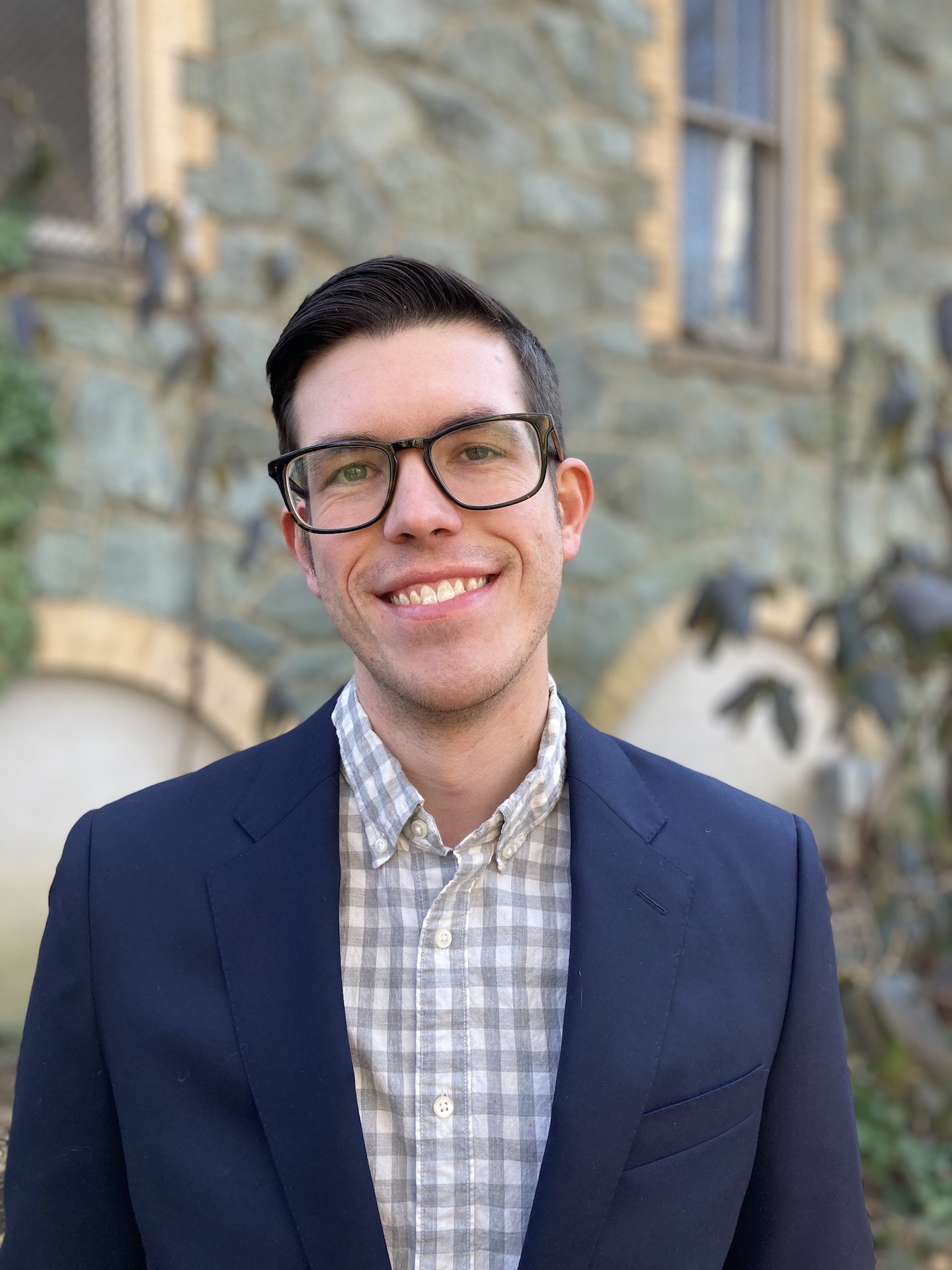
I am a philosopher of physics and I completed my Ph.D. in philosophy at
Johns Hopkins University in May 2025.
I am an instructor of philosophy at the University of Maryland Baltimore County,
where I teach philosophy of physics, philosophy of spacetime, and introduction to philosophy.
Until recently I was employed as a Knowledge Analyst,
working with
NASA's Spectrum Policy and Planning division to capture and maintain spectrum
management knowledge to train the next generation of spectrum managers.
During the 2020-2021 academic year I was a Graduate Student Cross-Training Fellow, and spent the
year studying astrophysics in the physics and astronomy department at Johns Hopkins.
The fellowship was supported by the Templeton Foundation and administered by the Society for Christian Philosophers.
The fellowship provided a terrific environment to further explore the connection between philosophy and astrophysics and I am
very grateful for the experience.
Contact: carledg1@jhu.edu
Download my CV
Download my CV
Research
My research lies at the intersection of philosophy and physics, with a particular
focus on the philosophy of quantum gravity, emergence, and gravitational dualities. I
am driven to understand the conceptual underpinnings of physical theories, especially
the emergence of gravity from quantum entanglement entropy and thermodynamical
processes. In my dissertation, From Chaos to Order: Assessing the Foundations of Emergent Gravity,
I trace the historical roots of emergent gravity back to Newton and explore its connections to microscopic dynamics.
I also examine the interplay between emergence, explanation, and gravity, ultimately arguing for a duality between information
(via entanglement entropy) and the Einstein Equations, building on Jacobson's insights. In future work, I plan to continue to investigate the emergence of space, time, and gravity from entanglement entropy.
In particular, I intend to investigate the
ER=EPR conjecture. This conjecture, proposed by Maldacena and Susskind, posits that quantum entanglement (Einstein-Podolsky-Rosen (EPR) correlations) and spacetime connectivity
(Einstein-Rosen (ER) wormholes) are complementary descriptions of the same underlying reality.
I have a strong interest in the history of physics and its role in informing the foundations of physics. I plan to undertake a project on the history
of relativistic thermodynamics from the 1930s to the 1970s, focusing on the impact of
Richard Tolman’s 1934 work, Relativity, Thermodynamics, and Cosmology.
This research influenced later developments in black hole thermodynamics and cosmology during the 1970s, yet its contributions remain underexplored.
Independently, I research the role the simplicity plays in scientific theorizing. I argue for an understanding based account of simplicity that is non-truth apt.
I my Master's thesis I argue against attempts to ground simplicity as an epistemic virtue through information-theoretic model selection criteria (e.g., AIC, BIC, etc.). In a separate
paper, I argue for simplicity as a non-epistemic understanding oriented theoretical virtue, using examples from modeling in astrophysics and cosmology.
Teaching
My teaching philosophy strives to foster the skills that students need to be successful, in both the academy and their careers, through an exploration of philosophical topics. These skills include reading comprehension, critical thinking, analysis, and the ability to clearly and concisely communicate their ideas. I endeavor to instill a sense of curisoity and the desire to become a lifelong learner in every student.
University of Maryland Baltimore County
Instructor of Record
- Philosophy of Physics (Spring 2020; Spring 2024)
- Philosophy of Space and Time (Fall 2021)
- Introduction to Philosophy (Fall 2019; Fall 2021; Fall 2023; Fall 2024)
Ohio University
Instructor of Record
- Principles of Reasoning (Fall 2014; Spring 2015)
Graduate Assistant
- Introduction to Ethics (Fall 2013; Spring 2014; Summer 2014)
Johns Hopkins University
Instructor of Record
- Philosophy of Quantum Mechanics (Winter 2019; Winter 2020; Winter 2022)
Graduate Assistant
- Philosophy and Science: An Introduction to Both (Fall 2018; Fall 2019)
- Introduction to Formal Logic (Spring 2019; Spring 2020)
Wayne State University
Instructor of Record
- Critical Thinking (Summer 2016)
Graduate Assistant
- Introduction to Ethics (Fall 2015; Spring 2016)